Photonic processors, leveraging light instead of electrons, are poised to revolutionize computing by offering unprecedented speed and efficiency. This shift is driving breakthroughs across diverse fields, from drug discovery and materials science to artificial intelligence and high-frequency trading, fundamentally reshaping industries and research capabilities.
Cross-Disciplinary Breakthroughs Driven by Photonic Processors and Optical Computing
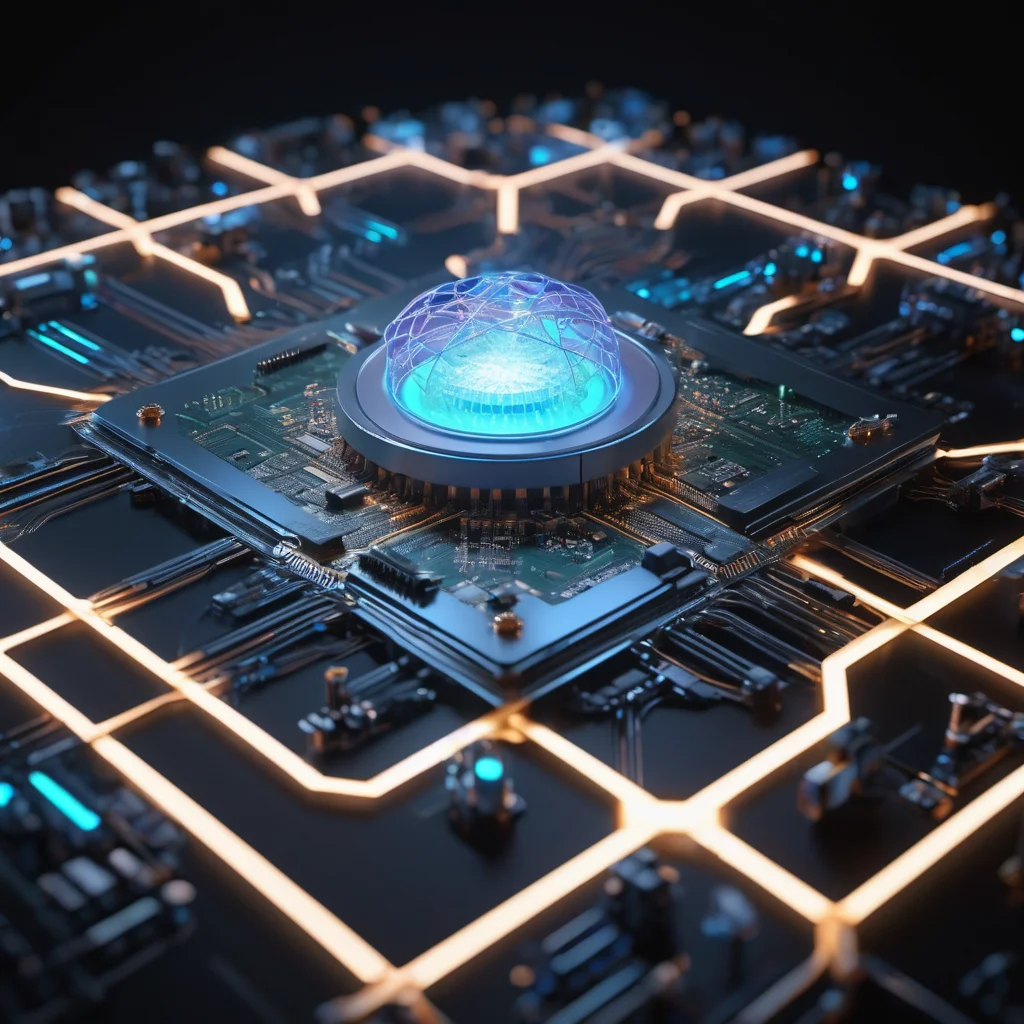
Cross-Disciplinary Breakthroughs Driven by Photonic Processors and Optical Computing
For decades, the relentless pursuit of faster and more efficient computing has been largely defined by Moore’s Law – the observation that the number of transistors on a microchip doubles approximately every two years. However, as transistors approach atomic scales, physical limitations are increasingly hindering further progress. Enter photonic processors and optical computing – a paradigm shift that utilizes light, rather than electrons, to perform computations. This article explores the current state of this technology, its burgeoning real-world applications, the profound industry impact, and the cross-disciplinary breakthroughs it’s enabling.
The Fundamentals: From Electrons to Photons
Traditional computers rely on electrons flowing through silicon circuits to represent and manipulate data as bits (0s and 1s). Photonic processors replace these electrons with photons – particles of light. Light possesses inherent advantages: it travels significantly faster than electrons, can carry far more information simultaneously (through wavelength division multiplexing), and generates less heat, a major constraint in modern electronics. Optical computing isn’t simply about using optical components; it’s about designing algorithms and architectures that inherently leverage the properties of light for computation.
Real-World Applications: Beyond the Lab
While still in relatively early stages of commercial deployment, photonic processors are already finding niche applications and demonstrating significant potential:
- High-Frequency Trading (HFT): The latency-sensitive world of HFT demands the absolute fastest processing speeds. Photonic circuits can execute complex calculations and route data with significantly lower latency than electronic systems, providing a crucial edge in the market. Companies like Lightmatter are specifically targeting this sector.
- Data Centers & Networking: Data centers are power-hungry behemoths. Optical interconnects, using light to transmit data within and between servers, are already deployed to reduce energy consumption and increase bandwidth. Photonic processors are being integrated to perform packet processing and routing tasks directly in the optical domain, further minimizing latency and power consumption. Intel’s Silicon Photonics technology is a key player here.
- Artificial Intelligence (AI) & Machine Learning (ML): Training complex AI models, particularly deep neural networks, requires immense computational power. Photonic processors offer the potential to dramatically accelerate matrix multiplication – the core operation in many AI algorithms. Lightmatter and PsiQuantum are developing photonic AI accelerators that promise orders of magnitude speedups compared to traditional GPUs.
- Quantum Computing Support: While not directly quantum computers themselves, photonic processors are vital for controlling and reading out qubits in some quantum computing architectures, particularly those based on photons. They act as crucial interface components.
- Optical Coherence Tomography (OCT): This medical imaging technique, already widely used in ophthalmology and cardiology, benefits from advanced photonic components for high-resolution imaging. Further advancements in photonic processing will enhance image processing and analysis in real-time.
- Materials Science & Drug Discovery: Simulating molecular interactions and materials properties is computationally intensive. Photonic processors can accelerate these simulations, enabling faster discovery of new drugs and materials with desired characteristics. This involves complex Fourier transforms and other mathematical operations that are well-suited to optical implementation.
Industry Impact: A Seismic Shift
The rise of photonic processors and optical computing is poised to trigger significant economic and structural shifts across multiple industries:
- Semiconductor Industry Disruption: While initially complementing existing silicon-based technology, photonic processors could eventually disrupt the traditional semiconductor industry. Companies specializing in photonics will gain prominence, while established players will need to adapt or Risk obsolescence. This requires significant investment in new manufacturing processes and design tools.
- New Job Creation: The development, manufacturing, and deployment of photonic systems will create new jobs in areas like photonics engineering, optical design, and specialized manufacturing.
- Increased R&D Spending: The complexity of photonic processor design and fabrication will necessitate increased research and development spending across both academia and industry.
- Reduced Energy Consumption: The inherent efficiency of photonic systems will lead to significant reductions in energy consumption across various sectors, contributing to sustainability goals and lowering operational costs.
- Geopolitical Implications: Control over photonic technology will become a strategic asset, potentially leading to increased competition and trade tensions between nations.
Cross-Disciplinary Breakthroughs: The Synergy Effect
The true power of photonic processors lies in their ability to catalyze breakthroughs across disciplines. Here are some key examples:
- AI & Neuroscience: Photonic processors are enabling researchers to simulate larger and more complex neural networks, leading to a better understanding of the human brain and potentially inspiring new AI architectures.
- Quantum Chemistry & Materials Design: Accelerated simulations of molecular interactions are revolutionizing the discovery of new catalysts, superconductors, and other advanced materials.
- Biophotonics & Medical Diagnostics: Combining photonic processing with advanced optical sensors is leading to more sensitive and accurate diagnostic tools for early disease detection.
- Cryptography & Secure Communications: Photonic circuits can be used to implement complex cryptographic algorithms with significantly higher speeds and security than electronic systems, crucial for protecting sensitive data.
- Metamaterials & Optical Engineering: The ability to precisely control light at the nanoscale, facilitated by photonic processors, is driving innovation in metamaterials – artificial materials with properties not found in nature – and advanced optical components.
Challenges and Future Outlook
Despite the immense potential, several challenges remain. Fabricating complex photonic circuits with high precision is difficult and expensive. Developing algorithms and software tools specifically tailored for photonic architectures is an ongoing effort. Integrating photonic processors with existing electronic systems presents significant engineering hurdles. However, ongoing research and development efforts are steadily addressing these challenges.
Looking ahead, we can expect to see:
- Increased integration of photonic components into existing electronic systems.
- Development of more sophisticated photonic processor architectures.
- Wider adoption of photonic AI accelerators in various industries.
- Emergence of new applications that leverage the unique capabilities of photonic computing.
Photonic processors and optical computing represent a fundamental shift in how we process information. As the technology matures and becomes more accessible, it promises to unlock unprecedented opportunities across a wide range of disciplines, driving innovation and transforming industries for decades to come.
This article was generated with the assistance of Google Gemini.