The convergence of decentralized networks, particularly blockchain technology, and multi-agent swarm intelligence (MASI) is creating emergent, self-organizing systems with unprecedented scalability and resilience. This paradigm shift promises to revolutionize fields from logistics and resource management to scientific discovery and even automated governance, fundamentally altering how complex problems are solved.
Decentralized Swarms
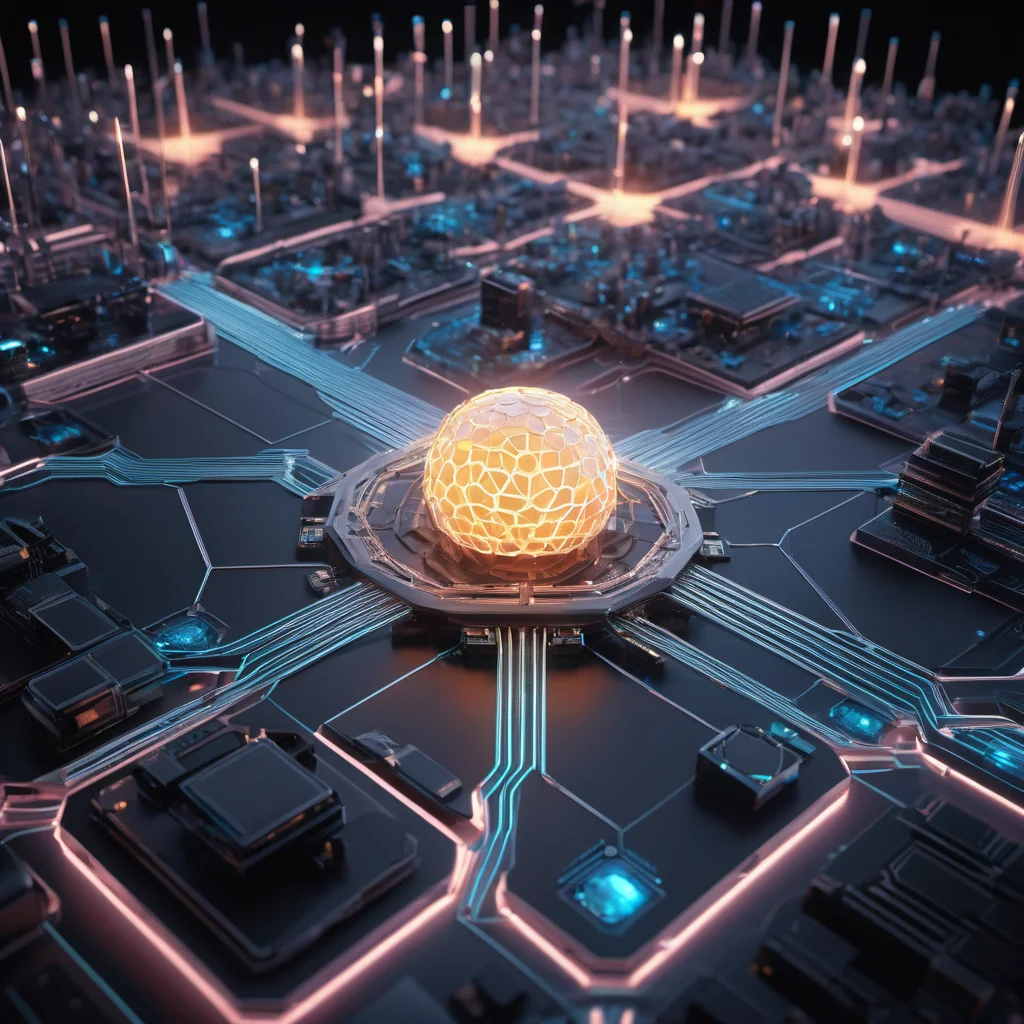
Decentralized Swarms: How Blockchain and Distributed AI are Reshaping Multi-Agent Intelligence
For decades, multi-agent swarm intelligence (MASI) has offered a compelling framework for tackling complex problems through the collective behavior of numerous, relatively simple agents. Traditionally, MASI systems have been hampered by centralized control, single points of failure, and limitations in scalability. However, the rise of decentralized networks, spearheaded by blockchain technology and increasingly sophisticated distributed AI architectures, is dramatically altering this landscape. This article explores the technical mechanisms driving this convergence, analyzes current research vectors, and speculates on the long-term global implications of decentralized swarms.
The Limitations of Centralized MASI and the Promise of Decentralization
Classic MASI, inspired by biological systems like ant colonies and bee swarms, relies on agents following predefined rules and communicating within a centralized infrastructure. While effective for certain tasks, this approach suffers from inherent vulnerabilities. A compromised central server can cripple the entire system. Scalability is also a significant hurdle; coordinating thousands or millions of agents through a central node quickly becomes computationally prohibitive. Furthermore, centralized control limits adaptability and innovation, as agents are constrained by the pre-programmed rules dictated by the central authority.
Decentralization, particularly leveraging blockchain principles, addresses these limitations. Blockchain provides a distributed ledger for recording agent interactions, establishing trust and transparency without a central intermediary. This aligns with the principles of Game Theory, specifically repeated games, where agents are incentivized to cooperate based on the expectation of future interactions recorded on the immutable blockchain. Malicious behavior is discouraged through reputation systems and potential economic penalties (e.g., token slashing).
Technical Mechanisms: Blockchain, DAGs, and Distributed Neural Networks
The integration of MASI and decentralized networks isn’t simply about replacing a central server with a blockchain. It involves a deeper architectural shift. Several key technical mechanisms are at play:
- Blockchain-Based Communication and Coordination: Agents can communicate and negotiate tasks via smart contracts deployed on a blockchain. These contracts can automatically allocate resources, resolve conflicts, and reward agents based on performance. The Byzantine Fault Tolerance (BFT) consensus mechanisms inherent in many blockchains ensure that the system can continue functioning even if some agents are faulty or malicious.
- Directed Acyclic Graphs (DAGs): Alternatives to traditional blockchains, such as IOTA’s Tangle, utilize DAGs. DAGs allow for parallel transaction processing and significantly higher throughput, making them particularly suitable for coordinating large swarms of agents requiring near real-time communication. This is crucial for applications like autonomous vehicle platooning or large-scale robotic manufacturing.
- Federated Learning (FL) for Distributed AI: Instead of relying on a centralized model, federated learning allows agents to train AI models locally using their own data. These local models are then aggregated to create a global model without sharing the raw data, preserving privacy and enabling collaborative learning across geographically dispersed agents. This directly addresses the challenge of data silos and enables MASI systems to adapt to diverse environments.
- Decentralized Reinforcement Learning (DRL): DRL extends federated learning by incorporating reinforcement learning principles. Agents learn optimal strategies through trial and error, and their experiences are shared and aggregated to improve the overall swarm performance. This enables the swarm to adapt to changing conditions and discover novel solutions without explicit programming.
- Agent-Based Modeling (ABM) with On-Chain Verification: ABM allows for the simulation and analysis of complex systems by modeling the interactions of individual agents. Integrating ABM with blockchain allows for verifiable simulations, where the rules and parameters of the simulation are transparent and tamper-proof, fostering trust and enabling collaborative research.
Current Research Vectors
Several research areas are actively exploring the intersection of decentralized networks and MASI:
- Supply Chain Optimization: Researchers are developing blockchain-based MASI systems to optimize logistics, track goods, and automate inventory management. Each agent could represent a truck, warehouse, or supplier, coordinating to minimize costs and delivery times. This aligns with the principles of Lean Manufacturing and aims to create more resilient and efficient supply chains.
- Decentralized Robotics: Teams are investigating the use of decentralized swarms of robots for tasks like search and rescue, environmental monitoring, and construction. The blockchain ensures secure communication and coordination, while federated learning enables robots to adapt to unpredictable environments.
- Autonomous Drone Coordination: Blockchain-based MASI is being explored for coordinating fleets of drones for tasks like package delivery, infrastructure inspection, and precision agriculture. This requires robust communication and collision avoidance mechanisms, which can be facilitated by decentralized consensus protocols.
- Decentralized Scientific Discovery: MASI systems, powered by federated learning and blockchain, can be used to analyze large datasets and accelerate scientific discovery. Researchers can contribute data and computational resources without compromising privacy, fostering collaboration and accelerating innovation.
Future Outlook (2030s & 2040s)
- 2030s: We can expect to see widespread adoption of blockchain-based MASI in niche applications like supply chain management, autonomous vehicle platooning, and decentralized robotics. The integration of DRL will lead to more adaptive and resilient swarm systems. Standardization efforts around agent communication protocols will emerge, facilitating interoperability between different MASI platforms.
- 2040s: Decentralized swarms could become a foundational technology for managing complex systems at a global scale. Imagine decentralized energy grids optimized by a swarm of smart meters and renewable energy sources, or autonomous agricultural systems that adapt to climate change in real-time. The convergence of MASI, advanced AI, and quantum computing could unlock entirely new capabilities, such as self-replicating robotic swarms for space exploration or automated governance systems that dynamically adapt to societal needs. The ethical implications of such powerful systems – particularly regarding accountability and bias – will necessitate robust regulatory frameworks and decentralized governance mechanisms.
Challenges and Considerations
Despite the immense potential, several challenges remain. Scalability of blockchain networks remains a bottleneck, although Layer-2 solutions and alternative consensus mechanisms are actively being developed. Security vulnerabilities in smart contracts and decentralized applications need to be addressed. The computational complexity of DRL and federated learning requires significant advancements in hardware and algorithms. Finally, the societal and ethical implications of increasingly autonomous and decentralized systems require careful consideration and proactive governance.
Decentralized swarms represent a paradigm shift in how we approach complex problem-solving. By combining the power of multi-agent intelligence with the robustness and transparency of decentralized networks, we are creating systems that are more scalable, resilient, and adaptable than ever before. The journey is just beginning, but the potential to reshape our world is undeniable.
This article was generated with the assistance of Google Gemini.