The convergence of synthetic biology and automated substrate optimization is revolutionizing agricultural practices by enabling the design of crops and microbial consortia that thrive on unconventional and waste-derived resources. This synergy promises to enhance food production, reduce reliance on synthetic fertilizers, and promote sustainable farming practices.
Engineering the Farm
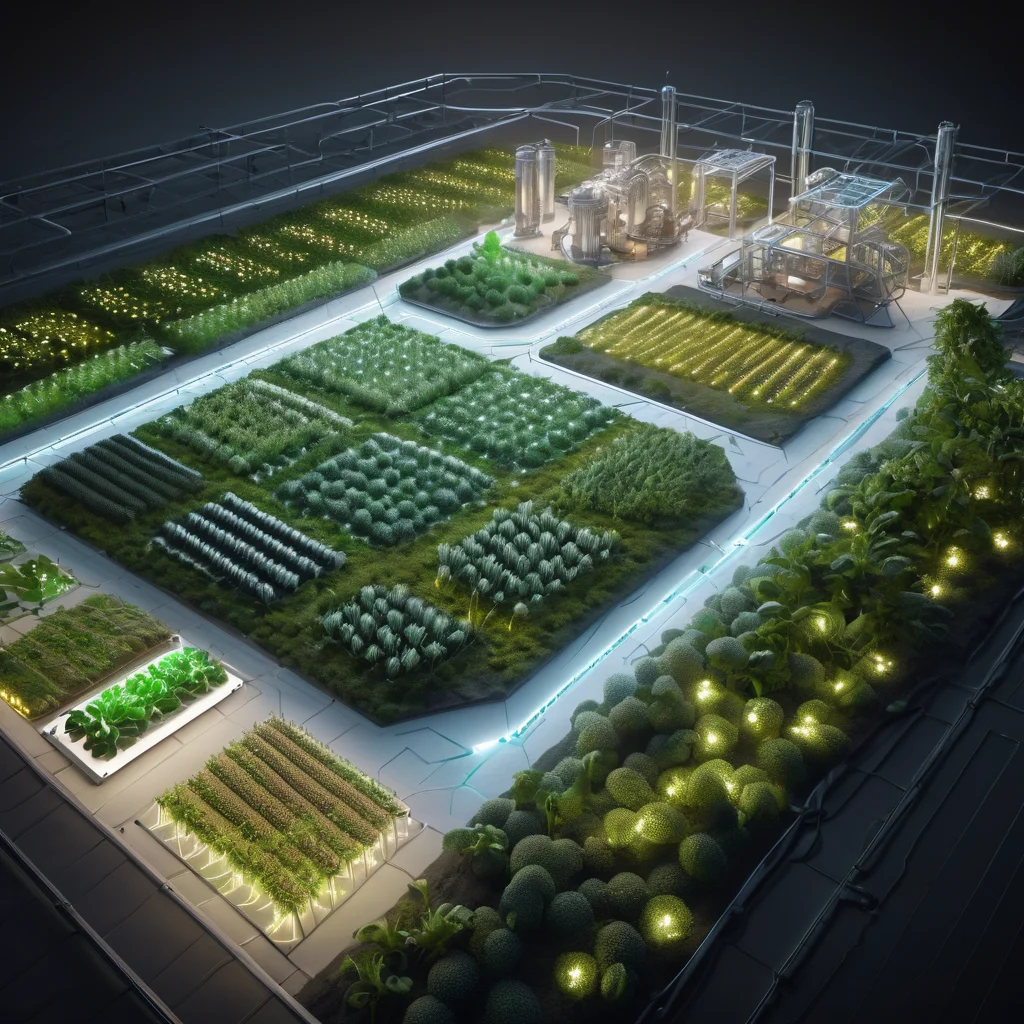
Engineering the Farm: How Synthetic Biology Intersects with Automated Substrate Optimization in Agricultural Tech
The agricultural sector faces unprecedented challenges: a growing global population, climate change impacting yields, and increasing concerns about the environmental impact of conventional farming practices. Traditional approaches are struggling to keep pace. A powerful and increasingly viable solution lies at the intersection of synthetic biology and automated substrate optimization – a combination poised to fundamentally reshape how we produce food. This article explores this burgeoning field, its technical underpinnings, current applications, and potential future impact.
The Core Concepts: Synthetic Biology & Substrate Optimization
- Synthetic Biology: At its core, synthetic biology applies engineering principles to biology. It involves designing and constructing new biological parts, devices, and systems, or re-designing existing natural biological systems for useful purposes. In agriculture, this translates to engineering microbes (bacteria, fungi, algae) and plants to perform specific tasks, such as nitrogen fixation, phosphate solubilization, pest resistance, and enhanced nutrient uptake. Genetic circuits, metabolic pathway engineering, and genome editing (CRISPR-Cas9 being a prime example) are key tools.
- Automated Substrate Optimization (ASO): Traditional agriculture relies heavily on readily available, but often resource-intensive, substrates like nitrogen-based fertilizers and phosphorus. ASO aims to identify the optimal nutrient mixtures and conditions for maximizing the performance of engineered biological systems – whether those are plants or microbial communities – using automated experimentation and machine learning. This goes beyond simple nutrient balancing; it seeks to unlock the potential of unconventional substrates, including agricultural waste, industrial byproducts, and even atmospheric carbon.
The Synergy: Why They Work Together
Synthetic biology provides the what – the engineered organisms with novel capabilities. ASO provides the how – the optimized environment for those organisms to thrive. Consider nitrogen fixation. While some plants naturally fix nitrogen, the process is often inefficient. Synthetic biology can engineer microbes to fix nitrogen more effectively. However, these engineered microbes have specific substrate requirements – a particular balance of carbon sources, micronutrients, and pH – to function optimally. ASO can then be used to precisely define these requirements, leading to significantly improved nitrogen fixation rates and reduced reliance on synthetic nitrogen fertilizers.
Technical Mechanisms: The AI & Biological Loop
The ASO process typically involves a closed-loop system driven by machine learning. Here’s a breakdown:
- Experimental Platform: A robotic platform is used to prepare and analyze a large number of experimental conditions. These conditions vary the concentrations of different substrates (e.g., glucose, glycerol, amino acids, phosphate salts, trace elements). Microfluidic devices are increasingly common for high-throughput experimentation.
- Biological Assay: A biological assay measures the performance of the engineered organism under each condition. This could be growth rate, product yield (e.g., a specific metabolite), or a functional assay (e.g., nitrogen fixation rate). Sensors and imaging techniques (e.g., fluorescence, optical density) are used for automated data acquisition.
- Machine Learning Model: A machine learning model (often a Gaussian Process Regression or a Neural Network) is trained on the experimental data. The model learns the relationship between substrate composition and organism performance.
- Neural Architecture (Example): A common architecture uses a feedforward neural network. Input nodes represent the concentrations of each substrate. Hidden layers, with activation functions like ReLU, extract complex interactions between substrates. Output nodes predict the organism’s performance metric. Recurrent Neural Networks (RNNs) are also being explored to model time-dependent responses.
- Optimization Algorithm: An optimization algorithm (e.g., Bayesian Optimization, Genetic Algorithms) uses the machine learning model to predict the substrate composition that will maximize organism performance. This predicted composition is then tested experimentally.
- Iterative Refinement: The experimental results are fed back into the machine learning model, which refines its predictions. This iterative process continues until a near-optimal substrate composition is found.
Current Applications & Impact
- Algae-Based Biofuel Production: ASO has been instrumental in optimizing the growth of algae for biofuel production, allowing them to utilize waste streams like wastewater and CO2.
- Microbial Fertilizer Development: Companies are using this approach to develop microbial fertilizers that fix nitrogen and solubilize phosphorus, reducing the need for synthetic fertilizers.
- Crop Stress Tolerance: Engineering plants to tolerate drought, salinity, or heavy metal contamination is being accelerated by ASO, identifying the optimal nutrient conditions to support these stress-response mechanisms.
- Insect Pest Control: Engineered bacteria can be used as biopesticides. ASO optimizes their growth and efficacy on unconventional substrates, reducing production costs and environmental impact.
- Precision Fermentation: Optimizing the media for microbial fermentation processes used to produce food ingredients (e.g., mycoprotein, alternative dairy proteins) is a key application.
Challenges & Limitations
- Data Requirements: Machine learning models require significant amounts of data, which can be time-consuming and expensive to generate.
- Model Complexity: Biological systems are incredibly complex, and accurately modeling their behavior can be challenging. Extrapolation beyond the training data can lead to inaccurate predictions.
- Scalability: Scaling up optimized conditions from laboratory scale to field scale can be difficult due to variations in environmental factors.
- Regulatory Hurdles: Genetically modified organisms (GMOs) face regulatory scrutiny, which can slow down the adoption of these technologies.
Future Outlook (2030s & 2040s)
- 2030s: We’ll see widespread adoption of ASO in controlled environment agriculture (CEA) – vertical farms and greenhouses – enabling highly customized nutrient solutions for optimized crop production. Personalized microbial consortia, tailored to specific soil conditions and crop needs, will become more common. Integration of ‘digital twins’ – virtual representations of agricultural systems – will allow for predictive optimization and proactive problem-solving.
- 2040s: AI-powered robots will autonomously manage entire agricultural ecosystems, dynamically adjusting substrate composition and environmental conditions in real-time based on sensor data and predictive models. CRISPR-based tools will become even more precise, allowing for the engineering of organisms that can directly utilize complex waste streams, like agricultural residues and plastic waste. We may see the emergence of ‘living factories’ – engineered microbial communities that produce valuable compounds directly within the soil, minimizing the need for external inputs. The ethical considerations surrounding engineered ecosystems will require robust governance frameworks.
This article was generated with the assistance of Google Gemini.