Multi-agent swarm intelligence (MASI) promises transformative applications, but its computational demands are rapidly exceeding current hardware capabilities, creating significant bottlenecks. Addressing these limitations requires innovative hardware architectures and algorithmic optimizations to unlock the full potential of MASI.
Hardware Bottlenecks and Solutions in Multi-Agent Swarm Intelligence
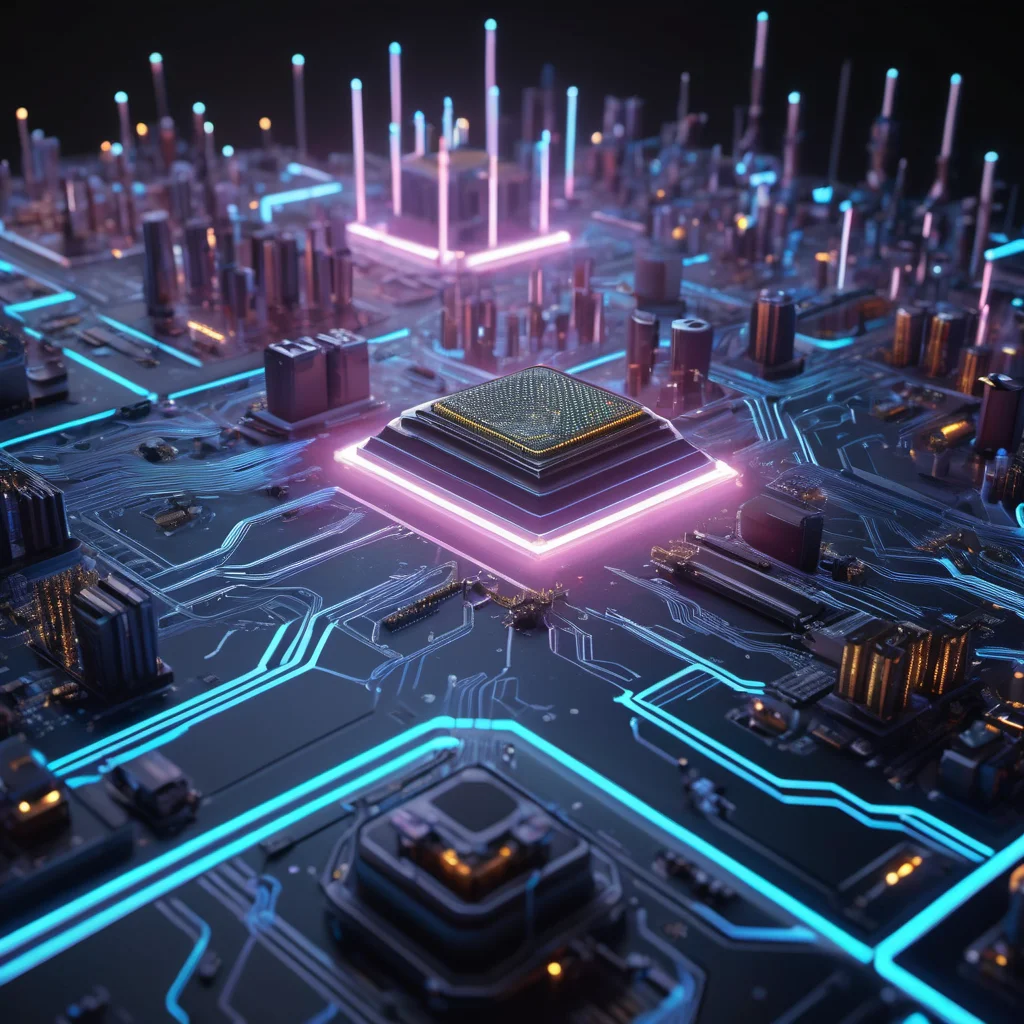
Hardware Bottlenecks and Solutions in Multi-Agent Swarm Intelligence
Multi-Agent Swarm Intelligence (MASI) is a rapidly evolving field inspired by the collective behavior of natural swarms like ant colonies and bee hives. It involves deploying numerous autonomous agents, each with limited capabilities, to solve complex problems through decentralized coordination and communication. Applications span robotics, resource allocation, environmental monitoring, and even financial modeling. However, the computational intensity of MASI is creating a critical bottleneck, hindering its widespread adoption and limiting the scale and complexity of deployable systems. This article explores these hardware limitations and examines potential solutions, focusing on current and near-term impact.
1. The Computational Challenge: Why MASI is Hardware-Intensive
The core challenge stems from the sheer number of agents involved and the constant communication and computation required for coordination. Consider a swarm of 1000 robots each running a neural network for navigation and obstacle avoidance, and simultaneously exchanging information with dozens of neighbors. This results in:
- Massive Parallel Processing: Each agent requires its own processing unit, demanding a highly parallel architecture. Traditional CPUs are fundamentally sequential and struggle to handle this level of concurrency efficiently.
- High Bandwidth Communication: Agents need to exchange information frequently. This necessitates high-bandwidth, low-latency communication networks, which are expensive and power-hungry.
- Memory Requirements: Each agent needs memory to store its local state, the environment map, and communication data. Scaling this across thousands of agents quickly becomes a memory bottleneck.
- Power Consumption: The combined power consumption of thousands of processing units and communication modules is a significant operational cost and a limitation for mobile or embedded deployments.
2. Current Hardware Bottlenecks & Their Impact
Let’s break down the specific hardware limitations:
- CPUs: While improved, CPUs remain inadequate for the sheer parallelism required. They are power-inefficient for this task.
- GPUs: GPUs offer significant parallelism but are often overkill for the specific types of computations involved in MASI. They are also power-hungry and generate substantial heat.
- FPGAs (Field-Programmable Gate Arrays): FPGAs offer reconfigurability, allowing for custom hardware acceleration. However, programming them is complex and requires specialized expertise. They also suffer from limited memory bandwidth.
- ASICs (Application-Specific Integrated Circuits): ASICs provide the highest performance and efficiency but are expensive to design and manufacture, limiting their applicability to high-volume deployments.
- Communication Infrastructure: Traditional Wi-Fi and Bluetooth struggle to provide the bandwidth and low latency required for real-time coordination. Wired networks are impractical for mobile swarms.
The impact of these bottlenecks manifests as:
- Limited Swarm Size: Simulations and real-world deployments are constrained by available hardware.
- Slow Response Times: Delays in communication and computation hinder the swarm’s ability to react to dynamic environments.
- Increased Energy Consumption: Limits operational range and deployment feasibility.
- High Development Costs: Specialized hardware and software development increase the barrier to entry.
3. Emerging Hardware Solutions
Several promising hardware solutions are emerging to address these limitations:
- Neuromorphic Computing: Inspired by the human brain, neuromorphic chips use spiking neural networks (SNNs) and analog circuits to perform computations with significantly lower power consumption than traditional digital architectures. This is particularly well-suited for the distributed, event-driven nature of MASI. Examples include Intel’s Loihi and IBM’s TrueNorth.
- Edge AI Accelerators: Specialized chips like Google’s Edge TPU and NVIDIA’s Jetson series are designed for low-power, high-performance inference at the edge. These can be deployed directly on individual agents.
- Spatial Computing Architectures: These architectures, like those being explored by Apple, aim to integrate processing and memory closer to sensors, reducing communication latency and power consumption. This is crucial for distributed MASI systems.
- Optical Interconnects: Replacing electrical interconnects with optical ones can dramatically increase bandwidth and reduce power consumption, enabling faster communication between agents.
- Wireless Mesh Networks (WMNs): WMNs provide robust, self-healing communication infrastructure for mobile swarms, overcoming the limitations of traditional Wi-Fi.
- RISC-V Processors: The open-source nature of RISC-V allows for highly customized processor designs tailored to the specific needs of MASI applications.
4. Technical Mechanisms: Neural Architectures in MASI
Understanding the underlying neural architectures is key to appreciating the hardware requirements. Common approaches include:
- Reinforcement Learning (RL): Agents learn optimal behaviors through trial and error, often using deep neural networks (DNNs) for function approximation. This requires significant computational resources for training and inference.
- Recurrent Neural Networks (RNNs): Used for processing sequential data, RNNs are crucial for agents that need to track their history and predict future states. Their inherent sequential nature limits parallelization.
- Graph Neural Networks (GNNs): GNNs are particularly well-suited for MASI, as they can directly model the relationships between agents. However, training GNNs on large graphs can be computationally expensive.
- Spiking Neural Networks (SNNs): As mentioned, SNNs offer a more biologically plausible and energy-efficient alternative to traditional DNNs. They operate on discrete spikes of electrical activity, allowing for event-driven computation.
5. Software Optimization & Co-Design
Hardware solutions alone are insufficient. Software optimization is equally crucial. This includes:
- Model Compression: Reducing the size and complexity of neural networks through techniques like pruning and quantization.
- Distributed Training: Training models across multiple agents or edge devices to reduce the computational burden on a single machine.
- Algorithmic Efficiency: Developing more efficient MASI algorithms that require fewer computations and communications.
- Hardware-Aware Algorithm Design: Designing algorithms specifically to leverage the capabilities of the target hardware platform (co-design).
Future Outlook
By the 2030s, we can expect neuromorphic computing to become more mainstream, enabling significantly larger and more complex MASI deployments. Edge AI accelerators will be ubiquitous, embedded in virtually every agent. Optical interconnects will begin to replace electrical ones, dramatically increasing communication bandwidth. The rise of quantum computing, while still nascent, could revolutionize MASI by enabling the solution of optimization problems currently intractable for classical computers.
In the 2040s, we might see fully integrated MASI systems where hardware and software are inextricably linked, with custom ASICs designed specifically for particular swarm tasks. Swarm intelligence will likely be a core component of autonomous systems in various industries, from agriculture and manufacturing to healthcare and space exploration. The ability to dynamically reconfigure hardware and software in real-time will be essential for adapting to changing environmental conditions and mission requirements. The lines between individual agents and the collective swarm will blur, leading to a truly distributed and adaptive intelligence.
Conclusion
Overcoming hardware bottlenecks is paramount to realizing the full potential of multi-agent swarm intelligence. A combination of innovative hardware architectures, algorithmic optimizations, and a co-design approach is essential to unlock the transformative capabilities of this exciting field.
This article was generated with the assistance of Google Gemini.